Five Basmati Varieties. Five Different Briefs.
A closer look at five modern Basmati varieties — where they came from, what they were bred to do, how their grain and cooking behaviour differ, and what those differences mean when the rice becomes a commercial specification.
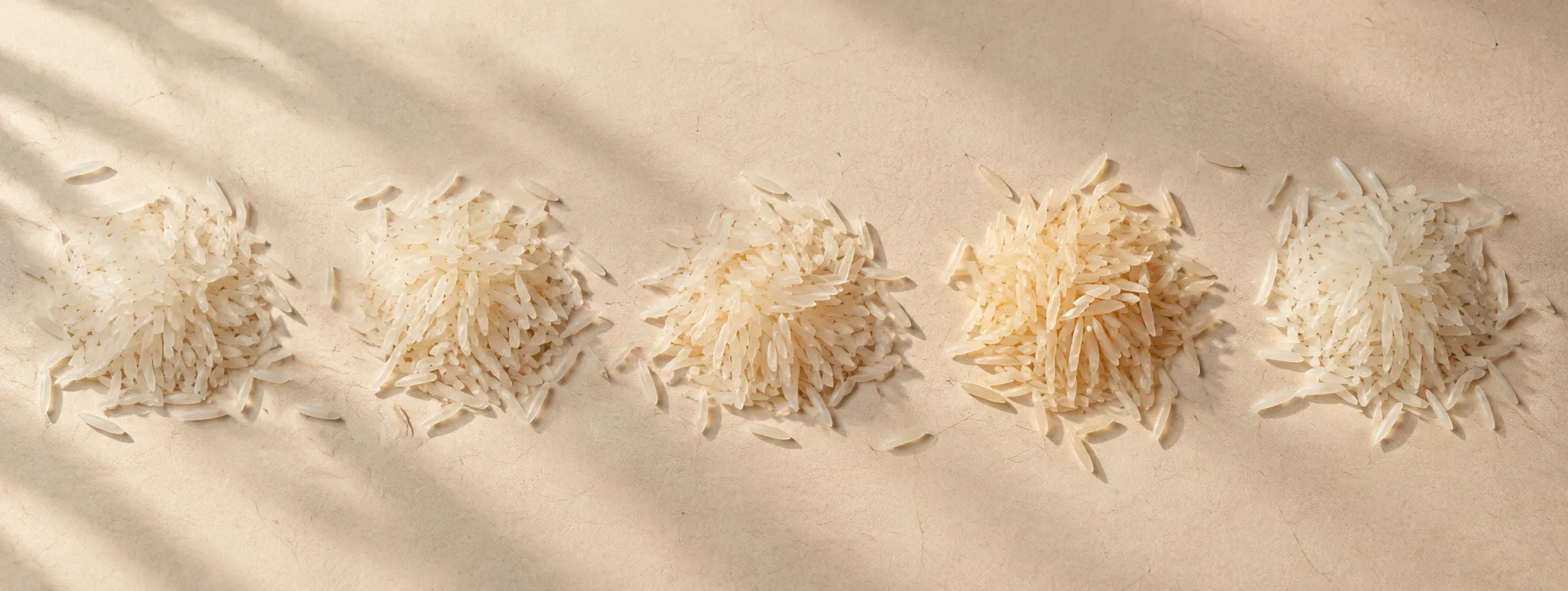
Basmati is not one uniform grain experience.
Five modern varieties bred at ICAR–IARI occupy different points in Basmati’s breeding history. Their differences become meaningful when grain characteristics, cooking behaviour, agronomy and the buyer’s requirements are considered together.
A variety is a breeding decision before it is a trade name.
Variety in context
A cross combines two parent lines. Backcrossing repeatedly returns to one parent while selecting for a desired trait; DNA markers can help identify that trait. The records below distinguish release chronology from documented breeding relationships.
A line of descent, as the records give it

Pusa Basmati 1121
2003
Cross
A 1991 cross of two Pusa lines with Basmati 370 and Type 3 in their ancestry, made to improve grain length and cooked elongation. Notified for Punjab and Haryana in 2008.
Pusa Basmati 6
Pusa 1401
2008
Crossfrom 1121
Pusa Basmati 1 × 1121. 1121 is one parent, not the only one.
Pusa Basmati 1509
2013
Crossfrom 1121
Pusa 1301 × 1121, known for a much shorter season.
Pusa Basmati 1718
2017
Marker-assisted backcrossfrom 1121
1121 as the recurrent parent, with two bacterial-blight resistance genes (xa13, Xa21) brought in from a donor line.
Pusa Basmati 1847
2021
Marker-assisted backcrossfrom 1509
1509 as the recurrent parent, with bacterial-blight (xa13, Xa21) and blast (Pi2, Pi54) resistance genes brought in.
Set in the order of release; each record names its own parents, which are not always the release before. Relationships as recorded by ICAR-IARI, ICAR and APEDA. Descent describes how a variety was bred, not what a lot of it will be.
Five varieties. Five different stories.
| Variety | Breeding | Published grain | Cooked | In the field | Useful for understanding |
|---|---|---|---|---|---|
| 11212003 | Cross of two Pusa lines; released 2003, notified 2008 | Extra-long, slender; 9.00 mm milled | 21.0–21.5 mm; elongation ratio 2.70 | 140–145 days; about 5 t/ha | The benchmark for length and cooked elongation |
| 17182017 | Marker-assisted backcross of 1121; 2017 | About 8.1 mm; very occasional chalkiness | About 17.0 mm; intermediate amylose | 135 days (ICAR); 136–138 (IARI, 2018) | A field trait added to a 1121 background |
| 1401 / PB 62008 | Pusa Basmati 1 × 1121; 2008 | Strong aroma; under 4% chalky grains | Uniform shape; 1121’s tapers at the end | Semi-dwarf, sturdy stem | An even cooked grain within the 1121 family |
| 15092013 | Pusa 1301 × 1121; 2013 | Extra-long, slender; about 8.2–8.4 mm | 17.6–19.1 mm, depending on the source | Semi-dwarf; 115–120 days | What a much shorter season changes, and what it leaves |
| 18472021 | Marker-assisted backcross of 1509; 2021 | Long, slender; 8.51 mm | 16.69 mm; intermediate amylose | 115–120 days (APEDA); other listings 120–128 | The 1509 season, with disease resistance bred in |
Figures are as each source published them; where sources differ the range is shown. They come from different trials, seasons and methods, so a row describes a variety and is not a head-to-head test. “Long” and “extra-long” are used differently by different sources (ICAR calls 1718’s 8.10 mm extra-long; APEDA calls 1847’s 8.51 mm long): the millimetres carry the information.
Read the table against the brief
What should the grain look like on the plate?
Cooked length is where the five differ most: about 21 mm for 1121, against about 17 mm for 1718 and 1847 and 17.6–19.1 mm for 1509. Where pronounced length carries the brief, read that spread first; where balance and repeatability weigh as much, read 1718 and 1509 for programme fit.
How must it behave through cooking and holding?
The table cannot say. Its figures describe a cultivar, from different trials and methods; cooking follows the lot and the process. Read them as the brief for a trial, then cook the lot, raw, steam or sella, in the vessel, batch and hold it will meet.
What does the programme need commercially?
Season and field resistance describe the crop, not the lot in the container. They matter where they bear on supply, repeatability and programme economics, and not at all to how the rice cooks. The service model decides which of these counts.

Programme fit is the decision
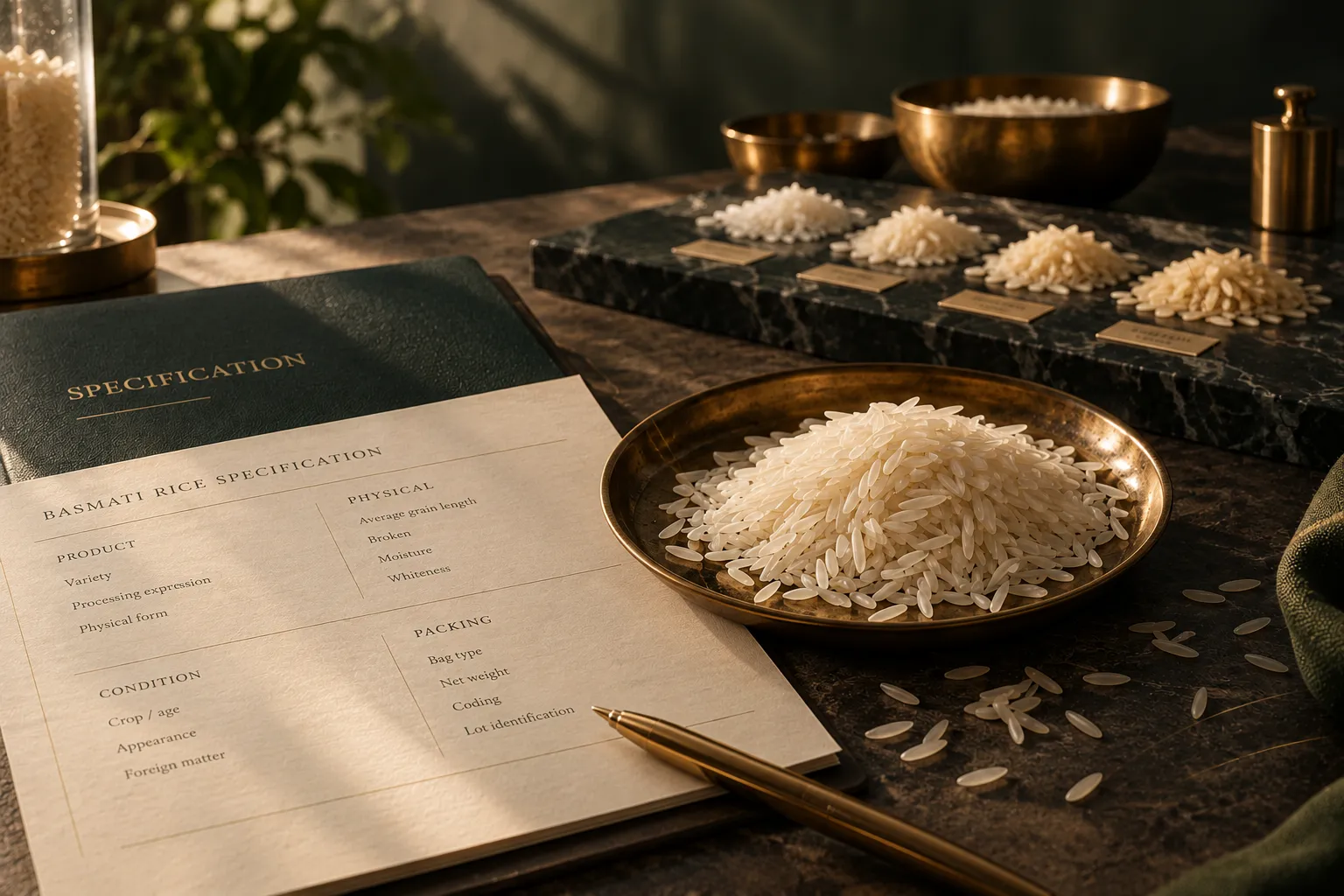
A varietal characteristic describes the cultivar as released and tested. Only the lot specification — variety and processing expression, length basis, broken tolerance, moisture, whiteness, crop or age and packing — is what a shipment is measured against.
The right variety is not simply the longest grain. It is the one whose physical and cooking behaviour fits the programme.