Bringing Basmati into Europe
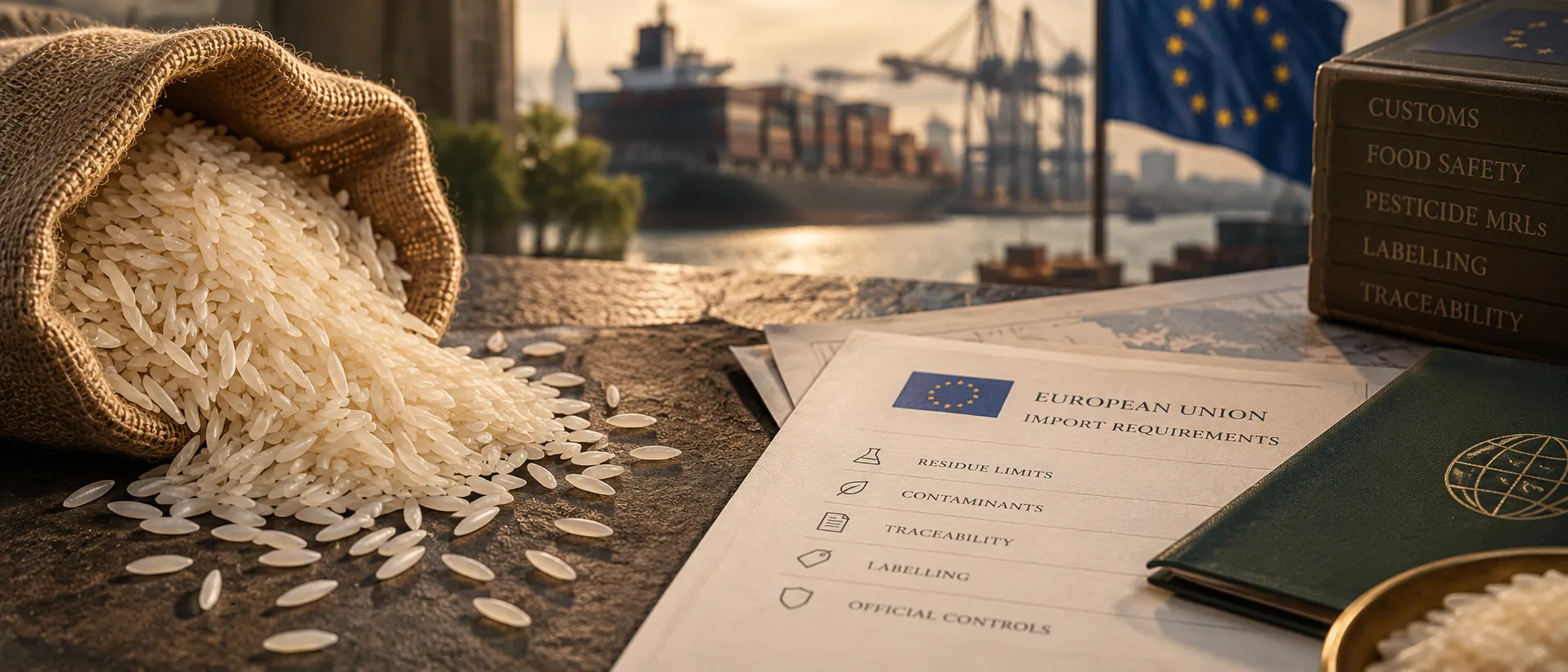
For an EU buyer, a rice specification is only one layer. Residue limits, contaminants, traceability, labelling and current official-control rules sit around the grain.
Product identity
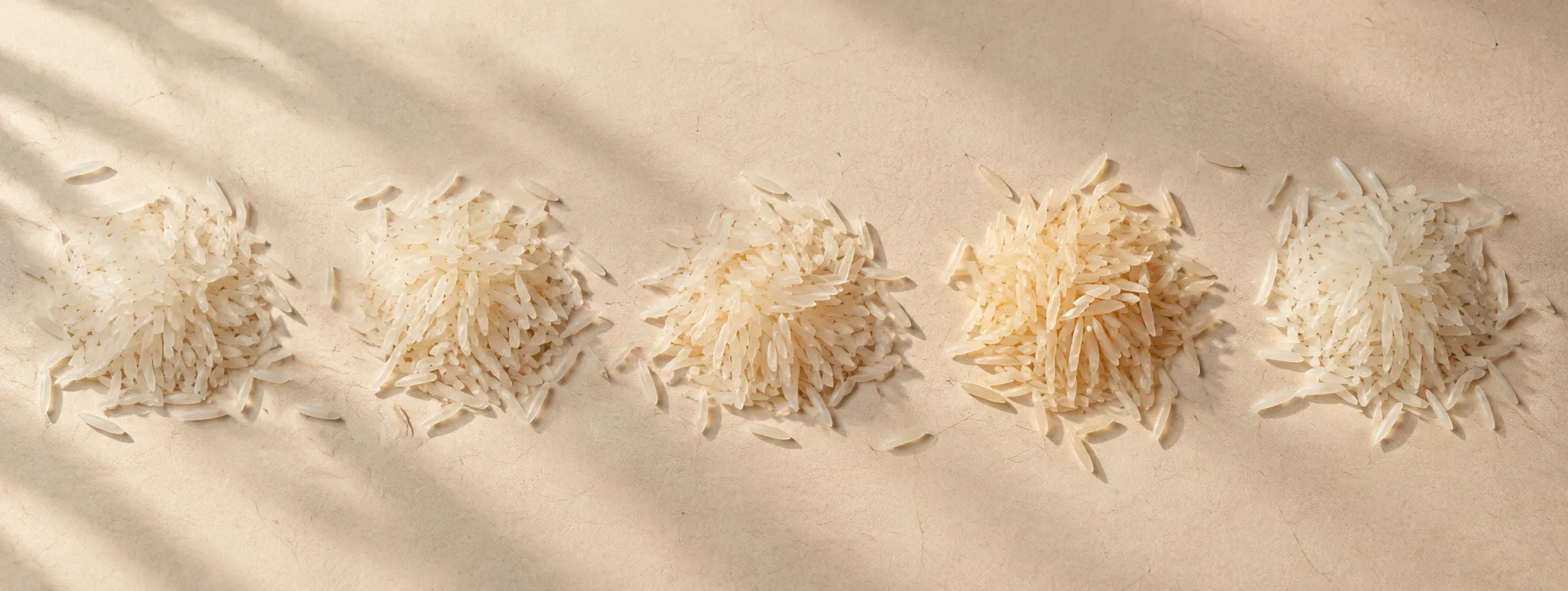
The first step is to make the rice and its paperwork describe the same thing: the variety, the processing expression, the physical form (paddy, husked, milled or parboiled), the packing, the intended channel and the customs classification. Commercial names are not a legal commodity description, and Basmati does not sit under a single CN code.
The classification decides which rules apply. The EU’s dedicated Basmati import regime, Delegated Regulation (EU) 2023/2835, covers husked Basmati rice under CN 1006 20 17 and 1006 20 98 of nine listed varieties: Basmati 217, Basmati 370, Basmati 386, Kernel (Basmati), Pusa Basmati, Ranbir Basmati, Super Basmati, Taraori Basmati (HBC-19) and Type-3 (Dehradun). It does not extend to milled rice.
Pesticide residues
EU maximum residue levels for pesticides are set principally by Regulation (EC) No 396/2005, substance by substance and commodity by commodity.
Separately, under the increased-controls framework of Implementing Regulation (EU) 2019/1793, as amended by Regulation (EU) 2026/1206, rice originating in India (CN 1006) is subject to a 10% frequency of official controls for pesticide residues at the border. That is a frequency of checking. It is not a residue limit, and it does not mean that every tenth consignment is tested in the same way: the frequency is applied across the entry as a whole, through identity and physical checks that can include sampling and laboratory analysis.
The practical response is a residue programme built around the crop, the origin, the destination’s maximum residue levels and the individual lot, with laboratory evidence that travels with the consignment.

Contaminants
Maximum levels for contaminants are a different matter from official-control frequencies. They are set by Regulation (EU) 2023/915, and every consignment has to comply with them whether or not its product is listed for increased checks.
For rice, the limits for inorganic arsenic are, for example, 0.15 mg/kg for non-parboiled milled rice and 0.25 mg/kg for parboiled and husked rice, so the processing expression decides which limit applies. Whether a product is currently listed says how often it is checked, not what it must comply with.
Traceability
Regulation (EC) No 178/2002 requires traceability to be established at every stage of production, processing and distribution (Article 18). A food business must be able to identify who supplied it and which businesses it supplied, and to make that information available to the authorities on request.
Commercially, that means one lot identity running through the whole chain: source, processing, packing, documents, shipment and destination. A lot code that appears on the bag but not on the invoice, or on the certificate but not on the packing list, is a break in the chain.
Packaging and food information
A private-label bag is not finished when the front panel looks right. For prepacked food, Regulation (EU) No 1169/2011 sets out the mandatory particulars in Article 9, to the extent that they apply. Not every particular applies in the same way to every rice product.
Mandatory information must appear in a language easily understood by consumers in the Member State where the food is marketed (Article 15). Origin is mandatory where leaving it out could mislead the consumer about the true origin of the food, or where another Union rule requires it (Article 26). Artwork should be approved before cylinders, plates or print runs are committed.

The Basmati import regime
Under Regulation (EU) 2023/2835, husked Basmati rice of the listed varieties under CN 1006 20 17 and 1006 20 98 qualifies for the zero rate of duty when it is accompanied by an import licence. The licence application is accompanied by a product authenticity certificate issued by a competent body in the exporting country, as published by the Commission, and Implementing Regulation (EU) 2023/2834 sets the certificate’s form: it is valid for 90 days from the date of issue. The applicant must also show that it exported from the Union, or released for free circulation in the Union, at least 25 tonnes of rice in one of the previous two calendar years, and licence rights are not transferable.
The certificate belongs to that regime. It is not a blanket requirement for every Basmati consignment.
Shipment file
Depending on the product, the contract and the destination requirements, the shipment file may include:
The important thing is that the documents describe the same physical product: the same variety and expression, the same lot, the same quantity and the same packing.
- Commercial Invoice
- Packing List
- Bill of Lading
- Phytosanitary or Fumigation Documentation, where applicable
- Laboratory Test Results
- Product Specification
- Authenticity Certificate, where required under the applicable Basmati import regime
- Other agreed export and import documentation
Buyer checklist
- Align the product description, variety, process and physical form.
- Align the applicable customs classification.
- Establish the applicable residue and contaminant requirements.
- Agree the evidence and laboratory documentation required.
- Approve the private-label artwork and the applicable mandatory food information.
- Ensure lot identity connects the physical consignment to the commercial file.
Compliance is not one certificate.
It is the consistency of the specification, evidence, documentation and physical shipment.